Sunday, January 12, 2014

4 January 2014: Te Papa and Picton

Today was a big day, as we visited the marvelous national museum, Te Papa, and rode the enormous ferry, the Interislander, from Wellington to Picton in the evening.  We had some angst once we arrived in Picton, but let’s not get ahead of ourselves!

Te Papa is a museum with stunning displays and beautiful artistry.  The foci of today’s trip was on the geology of New Zealand, including the origin and potential danger of earthquakes in New Zealand, and the Treaty of Waitangi, the document written by British colonists and signed by Maori chiefs that amounted to the chiefs signing-away their privileges to Queen Victoria in the 1800s.  In addition to these two items, the students learned about the means by which the early Maori (Polynesians that arrived around 1000 A.D. in New Zealand) traveled the South Pacific and the types of adaptations plants in New Zealand have.  Several hours in the museum was enough for the students and then it was out to do some exploring of Wellington.  The last few hours on the North Island were spent shopping and grabbing a bite to eat…and for me, the reading of the first week’s-worth of journal entries written by the students.

In the evening, we caught the Interislander ferry to Picton, which proved to be a relatively benign trip given the relatively high winds that blew across the area this evening.  Unfortunately, our luck didn’t extend to our brief time in Picton.  Allow me to elaborate…


After landing in Picton, I walked to the Rental Car New Zealand site and learned that our rental van (only 339,000 km on it!) did not have a trailer!  So, our students spent the brief car ride from the ferry terminal to the hostel with their 30-40lb backpacks sitting on their laps!  Then, once we arrived at the hostel, we were without keys to get in!  Another visitor to the hostel was kind enough to tell me where our keys were hidden, but the surprises weren’t through yet!  Upon entering the hostel, our students determined that one of the rooms, which was to house 4 men, was already filled with 4 people!  Yikes!  So, at 1am, our women settled into their room, a room housing 3 of our men took two more who slept on the floor, and myself and Dr. Moran slept on the floor so two of our male students could have beds.  It was a crazy evening…


Our group in front of Te Papa, the national museum of New Zealand.

Friday, January 10, 2014

3 January 2014: Karori Sanctuary, Wellington

A big day is in-store for us!  Our students were ready on time (they’re fantastic like that, really!), but we faced an immediate obstacle to our day: the high winds from yesterday blossomed into a full ‘southerly’ (a gale-force wind blowing to the south).  To boot, torrential rain accompanied the wind later in the morning, which eliminated doing anything outdoors!

Our guide for the day, Russ, a facilities manager, gave us an introduction to the history of animals in New Zealand, the geology and formation of the ‘sinking’ continent of Zealandia (only 5% of the continent remains above water; that land is known as New Zealand!), and the ways in which the conservation goals of the sanctuary are achieved.  Russ was a witty Kiwi and kept our students smiling as the lesson proceeded.  We learned that the major predators of the birds and reptiles of New Zealand, weasels, stoats (similar to our long-weasels), ferrets, and rodents (mice and rats), were eliminated from the sanctuary over the period of 1990-1995, and then the reintroduction of native species began, as the land was now free of predators.  Today, several hundred Brown Spotted Kiwi, North Island Saddlebacks, and North Island Robins inhabit the Karori Sanctuary.  The sanctuary serves as a beacon for what many Kiwi (inhabitants of New Zealand) ultimately hope for the country: to be rid of introduced predators and the recovery of the precious birds and reptiles whose populations were decimated after humans arrived in New Zealand.

Following Russ’ presentation, our group had a walk through the informative multi-room display in the main building, which included an amazing movie on the history of New Zealand from the time before humans arrived until the present.  The students were captivated by the portrayal of the mighty Moa, a group of 11 species whose largest species stood at 9 feet (3m) tall!  We had the chance to ask Russ more questions about the species of bird now inhabiting Karori following our visit of the exhibit and it was impressive to hear our students ask such detailed, informed questions.  Right on!  Score points for Mount Saint Mary College students!  A clearly-impressed Russ had bad news for us, though: the howling wind was now accompanied by torrential downpours, which would preclude any work taking place outside.  Rats (pardon the pun)! Our second ‘service’ project was thwarted!  Ah well, we should score points for our good intentions!

The rest of the day was spent dodging rain drops.  Many students focused on completing their main assignments for the trip (daily journals and journaling on the activities that we participated in, e.g., listening to Russ’ presentation at Karori in the morning), or jockeyed for the few washing machines found in the hostel.  The rained did stop later in the day and it afforded us an opportunity to visit Mt. Victoria, one of the tallest points in the harbor around Wellington, and conveniently located ‘just’ up the hill from the hostel.  A 10-min van ride up a 15% grade hillside landed us at the top and afforded us incredible views of Wellington and the Lower Hutt region of the North Island.  At 10pm, when it was just nearly dusk, we made our way back to the hostel.  It was a mixed-up type of day, but it turned out well in the end!


Tomorrow: Te Papa, the national museum, and our ferry ride to Picton.


Russ, Operations Manager at the Karori Sanctuary, talks to our group about the sanctuary and the history of New Zealand.


Sean Harrison (Business, 2016) holds a mounted specimen of an Australian Possum, a predator introduced to New Zealand for its fur, but quickly became a pest species that ate native wildlife.


Me holding a mounted specimen of a juvenile Little Spotted Kiwi from the Karori Sanctuary.


Our intrepid group that drove to the top of Mt. Victoria.  Wellington, the capital city, is in the background.

2 January 2014: Mt Doom and Wellington

Following our night in Rotorua, our group started with grand aspirations: climb Mt. Ruapehu, or as fans of the Lord of the Ring series more affectionately know it: Mt. Doom.  Mt. Ruapehu lies with its two siblings in a series of volcanoes between Rotorua and Wellington.  Tongariro National Park lies to the south of New Zealand’s largest lake, the crater lake called Lake Taupo.  Our beast of a rental van (Toyota Hiace with 330,000 km on the odometer!) met its first challenge of hills on this expedition and readily failed…not only did we struggle to progress any inclines very quickly, it also dumped copious amounts of antifreeze once we pulled into the Whakapapa Ski Area chairlift site, the location where one can take a chairlift partially the way up Mt. Ruapehu.  As Dr. Moran and I sat in the parking lot awaiting our car roadside assistance to arrive (a process lasting two hours!), the students rode the chairlift and then returned, with the hopes that our car would not be towed to the nearest town for repairs.  The mountain views from the top were described as ‘breathtaking’ and ‘amazing’ and the ride down from the top was generally characterized as ‘freezing!’.  The mountain top was at least 15-20F colder than the town we visited just prior to our ascent, but who could know what it would be like when it’s summer!  The landscape of Mt. Ruapehu was just as it appeared in LotR: desolate, forbidding, stony, and, well, desolate!  Peter Jackson definitely picked the right place for Mt. Doom cinema!

Aside from the good news that all 10 of our students made it back to the van, our Kiwi mechanic, Dave, informed us that the van must have gotten good-and-heated-up over the drive up Mt. Ruapehu and boiled over the excessive amount of coolant in the reservoir.  Whew!  We dodged a bullet!  We got on the road immediately and made our way to relatively gloomy Wellington later in the afternoon.


The YHA Wellington is located in the heart of Wellington, the capital of New Zealand.  In close proximity to the hostel are plenty of restaurants, pubs, and stores, as well as the national museum, Te Papa.  As we arrived in town, it was clear our good weather fortune had changed.  ‘Windy Welly’ was living-up to its name: the wind was only blowing ~20-30mph…and it had yet to start raining.  Most students ran across to the ‘New World’ grocery store across the street from the YHA for food and had a quick meal before retiring for the evening.  We needed our energy for the next morning, when we would visit the Karori Sanctuary (a.k.a., Zealandia) for a lesson on the initiatives at the ‘mainland island’ nature reserve, a guided tour of the sanctuary, and our service project (brush removal).


Mt Ruapehu and the Whakapapa Ski Area, with Dr. Moran walking in the foreground (orange coat).


Dr. Moran points out Mt Ruapehu as we wait for the roadside assistance to arrive and assess our van.

1 January 2014: Auckland and Rotorua

Our morning started more slowly than most as many of our students were out enjoying the international New Year’s Eve celebration.  Today’s activities were relatively simple: drive to Rotorua and enjoy an evening of Maori culture, including a traditional dinner.  We traveled from Auckland and its background of volcanic silhouettes to one of the few sites on Earth where geysers occur (Yellowstone National Park and Iceland are the other regions).  Our arrival in Rotorua was greeted with tell-tale sign of geysers: the smell of sulphur oxide (the potent odor of rotten eggs!).  The students deposited their bags into the YHA (Youth Hostel Association) and were off to explore the small, but tourist-friendly, town of Rotorua.  A few students found the choice (Kiwi for ‘excellent) pub that has Irish plates for lunch specials, then all were ready on time (as always, it seems) for our evening at Te Puia.  Te Puia is a family-run Maori experience that includes guided tours of the geysers around the facility, background on the Maori tribe (iwi) living in the area through time, some of the cultural practices of the Maori, including weaving and wood-carving, traditional song and dance of the Maori, and a meal cooked in the Earth (a hangi).  Our first experience at Te Puia began with our guide, Carl, pulling our group aside from a large group of tourists, and leading us on an entertaining tour of the facility.

Carl was quite the tour guide: he sprinkled humor among the Maori stories, answered questions our group had on Maori traditions or the natural phenomena all around us, and perhaps extended the truth of some stories (for effect, clearly).  Everyone got a kick out of Carl and he was terrific to have as our guide for the afternoon.  One of the fascinating things we learned about the delicate nature of the ground surrounding the geysers.  As the hot water/vapor/gases escape the ground, the minerals from the water drop around the geyser as the water evaporates in the air.  The minerals then form deposits that appear thick and solid, but they are anything but!  The crusts formed by the minerals can easily crack and break, and the subsequent holes can be large enough to swallow whatever caused the break in the first place.  In the past, Moa, large flightless birds that weighed up to 1000 lbs sometimes broke through the crust and died after either failing into the hole and the boiling water below or died after failing to get out of what could be a relatively deep hole.  Furthermore, the Haast Eagle, an extinct raptor that lived in New Zealand prior to humans arrival, would sometimes attempt to retrieve a sunken Moa and end up getting stuck in the hole as well. Oops!

Following our tour, we had the opportunity to witness a traditional welcoming of strangers into the home of a Maori tribe.  The host family sent a warrior out to make an offering of peace to a representative of our group (we tried to convince Sean Harrison of our group to do the honors to no avail).  Upon our ‘chief’s’ acceptance of the peace offering, we then entered the home (a reception room lined with traditional wood carvings) and were ‘officially’ welcomed by the tribe.  After several songs, the audience had the opportunity to learn a Maori dance performed by the women of the tribe or the war dance, called the ‘haka.’  Kristen Maddock (Biology/Pre-med, 2019) and Lara Guindi (Biology/Pre-med, 2016) learned and performed the poi dance, which involved the swinging of a white ball attached to a length of red twine.  Out of the group, our women were the best at the dance! Following the poi dance, our host family performed a haka, the war dance used to simultaneously excite the performing tribe and terrify the witnesses!  After a rousing performance, the family welcomed all of our young men to the stage to learn the steps/body slaps/shouts performed during the haka.  I haven’t seen the video yet, but I felt like our group was pretty threatening!  Following our haka, we soon made our way towards dinner…

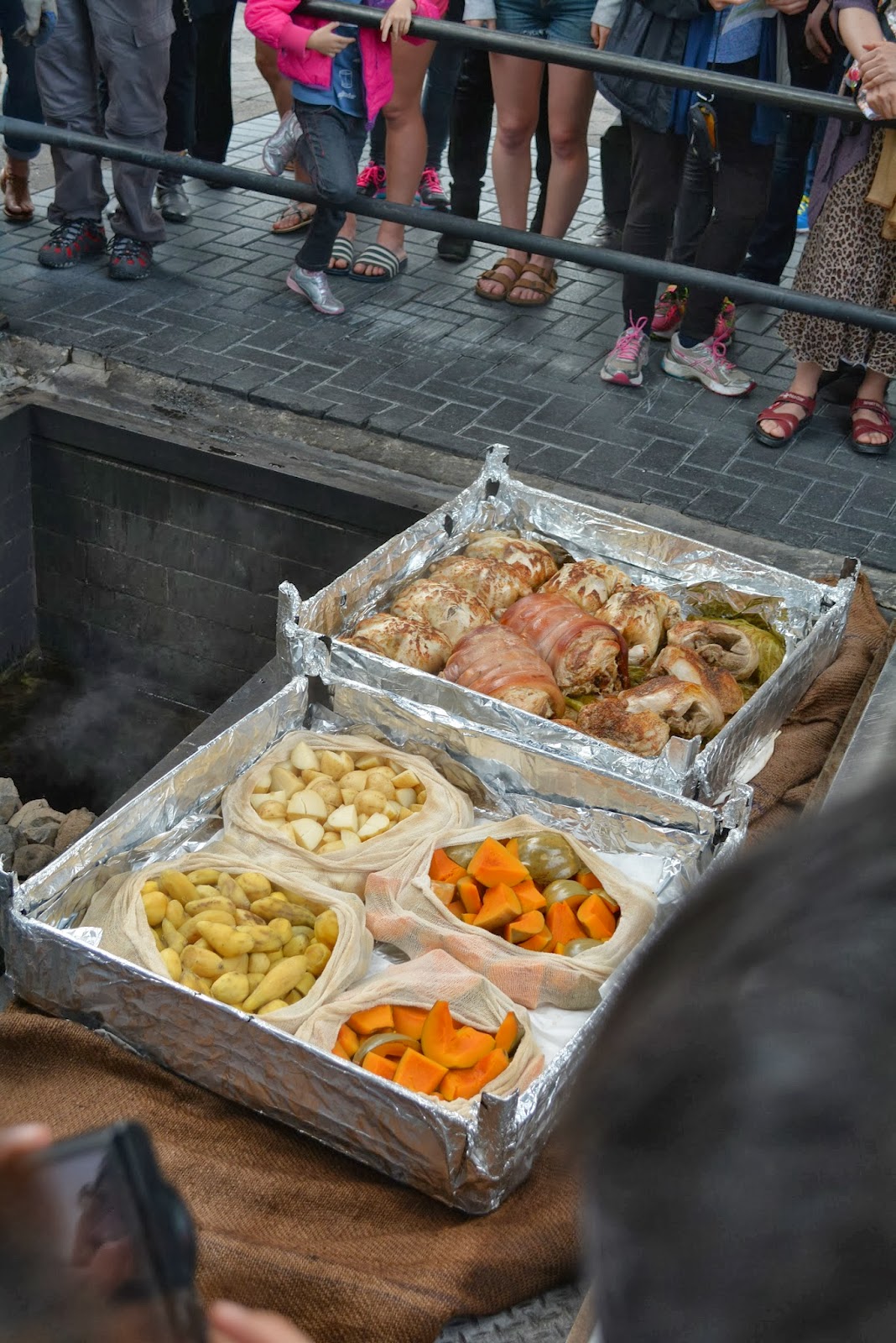
The Maori traditionally cooked meals in the Earth and called the meal a ‘hangi’.  A hole would be dug, then filled with hot coals, then the food, and then covered with a plant material to prevent the soil from spoiling the food during the day-long cooking process.  After our evening of song and dance, we watched as our hangi was removed from the ground.  The food, potatoes, kumara (sweet potato), lamb, and fish, and more, looked and smelled sumptuous!  We made our way to our tables and then enjoyed the fruits of the Maori family’s labor….my goodness…this meal will undoubtedly be the best meal of the trip!  It would be misleading to say that our students and James Moran (Natural Sciences) and I ate well tonight; we ate gluttonously!  Of course, we’ll need that energy come the next few days!

Our night ended with another trip around the geysers and hot chocolate for our efforts.  What a tremendous experience!

Carl talks to our group about the silver fern, one of New Zealand's national symbols.


 A Maori warrior blows on a ceremonial horn that welcomes us into his family's greeting house.

Kristen Maddock (Biology, 2019) and Lara Guindi (Biology/Pre-med, 2016) perform the poi dance.


Kate O'Driscoll (Biology/ Pre-med, 2016) and Lara Guindi (Biology/ Pre-med, 2016) listen to Carl talk about the geysers at Te Puia.


Kate O'Driscoll (Biology/ Pre-med, 2016), Lara Guindi (Biology/ Pre-med, 2016), Chris Lorch (Nursing, 2019), Jason Lorch (Biology/ Pre-med, 2016), Dorian Shann (Physical Therapy, 2016) , and Jack Capetola (Chemistry, 2016) in front of the major geyser at Te Puia, Pohutou.


Our traditionally-cooked Maori meal (hangi) just after it was removed from the ground!


Our group getting ready to enjoy an incredible Maori meal!

Wednesday, January 1, 2014

31 December 2013: New Year's Eve

New Year's Eve in Auckland is pretty special, as it is one of the first major cities to welcome the new year.  This year, the weather was outstanding and it seemed to be reflected in the vibe throughout the city: people were playing drums and singing, cars moving slowly along Queen Ave (the major thoroughfare into Auckland city centre) were thumping with loud music.  The atmosphere was definitely festive!

Dr. Moran and I made our way down to the center of action, the intersection of Victoria and Queen Sts, just before midnight, in order to see the traditional fireworks display on the Sky Tower.  Once again, we weren't disappointed as the LED countdown on the Sky Tower hit zero: a fireworks display lasting several minutes lit the night sky as revelers cheered and hugged one another in celebration of the new year.  It was also a time to reflect, if just for a moment, on how fortunate I am, our group is, to be traveling in a spectacular country like New Zealand, but also to consider how we would not be here without the support of our families at home.  If you haven't heard 'thank you' from your child yet for helping him/her get to New Zealand, please know each student has remarked on how lucky each feels to be here.  Thanks and Happy New Year!

The Sky Tower, in downtown Auckland, lights-up the night sky in celebration of New Year's 2014!

31 December 2013: Goat Island Discovery Centre & snorkeling

An early start to New Year's Eve saw us drive about 1.5 hrs north from Auckland to the sleepy seaside town of Leigh.  Today's itinerary included a visit to the Goat Island Discovery Centre, an extension of Auckland University, and the nearby beach for some snorkeling.

On the way to the Discovery Centre, we visited with Kerry at the Goat Island Dive shop (www.goatislanddive.co.nz) to be fitted for our snorkeling gear.  Kerry was instrumental to making our gear 'hire' a super-smooth operation and we extend our sincerest gratitude for her help!  We then drove a little ways down from the gear shop to the Discovery Centre, located immediately up the hillside from the beach we'd later snorkel from.  Peter Crabb was kind enough to introduce our students to marine science and the origins of the Discovery Centre in the 1970s.  Peter, a marine biologist and underwater cameraman and film producer, shared with us some of the factors that impact marine systems, including overharvesting of marine resources and acidification of the oceans.  A newly-minted PhD student, Leo, shared with us the types of graduate research being undertaken at the Discovery Centre and his own experiences as a graduate student.  Leo and Peter described to our students the excitement of conducting research and highlighted some of the potential career paths biology majors might follow after graduation (a good discussion for some of our junior biology majors!).  After a visit at the 'touch table', where students could touch & pick-up sea cucumbers, sea stars, scallops, sponges, and hermit crabs, we headed out to the beach for some snorkeling!
 David Hobbs (Business), Stephen Maccleod (Business), and Kristen Maddock (Natural Sciences) discuss details of one of the information panels in the Goat Island Discovery Centre in Leigh.

Leo (far left) and Peter Crabb, marine biologist at the Discover Centre (sitting in center, back) talk to our group about research taking place at Auckland University.

Chris Lorch (Nursing) handles one of the many sea cucumbers in the 'touch tank'.  Leo, our post0graduate host, conducted research on sea cucumbers and its cultivation as a food source.

The beach where we snorkeled from near the Goat Island Discovery Centre.  Not a bad place to be in the middle of our Northern Hemisphere winter!  The weather was outstanding: 75F, clear, with a slight breeze coming from the sea.  The water was a bit chilly (low 60s F), but long sleeve and pants wet suits minimized the effects of the cold!  We saw ~10 different species of fish during our snorkeling, and also saw a squid, some sea sponges, and a few hermit crabs.  More pictures of our snorkeling adventure will follow soon!

30 December 2013: Tiritiri Matangi island science reserve

Day 2 of our trip had us visit the off-shore scientific research reserve called Tiritiri Matangi.  We caught the Tiri Kat ferry from Auckland Harbour in the morning and made the 1.5 hr trek to the island.  After a quick greeting from the Department of Conservation (DoC) ranger, Jason, we were met by our personal guides, Simon & Morag Fordham.  Simon & Morag have been volunteers on Tiritiri for the last 17 years and are part of the 'Supporters of Tiritiri Matangi' group that help care for the island and its native plants and animals.  Our tour worked its way down a coastline where Simon described the origins of New Zealand and the organisms that evolved on the islands over the last 80 million years.  We were fortunate enough to see a nesting Variable Oystercatcher female brooding her eggs in a nest right on the beech!  Mom patiently watched as we all snapped some amazing pictures of this species of concern.  From the beach, we wove through native stands of trees and shrubs, looking for and listening to the chattering of the North Island Saddleback, Whiteheads feeding their begging offspring, and inquisitive Bellbirds visiting a nectar feeder designed by Simon. It was a great tutorial on the flora and fauna of Tiritiri and it was impressive to hear about the extraordinary efforts made by the grassroots 'Supporters' organization.  Our group then moved onto the beach for a little dip before we headed back to Auckland for dinner and work on daily journals.  It was a fantastic day!

Our group walking past the roped-off site harboring the Variable Oystercatcher female on her nest.

A North Island Saddleback investigating us as we walked through its territory.

Bellbirds visiting the nectar feeder designed to provide food, but also a convenient site to catch the birds!

 Our group posed for a snapshot atop the island of Tiritiri Matangi.  Behind the group is one of the oldest lighthouses in New Zealand and in the Hauraki Gulf.
 The critically endangered Takahe, a flightless bird, makes its way across the lawn near the Visitor's Centre.  Only 260 individuals of this species remain alive (and we got to see at least 2 of them!)
The Kokako, or Blue-wattled Crow, another endangered species, sat preening its feathers after bathing in a water trough along the Wattle Valley trail on Tiritiri Matangi Island.  According to Morag Fordham, an 'amateur' scientist tracking the Kokako on Tiritiri, the island's population is probably one of the densest aggregations of this species in New Zealand.